Escape the AI Efficiency Trap: Why Output-Based Pricing Is Your Bridge to Higher Margins
Hourly billing punishes agencies for getting faster with AI. Output-based pricing is the practical bridge to value-based pricing and 60%+ gross margins.
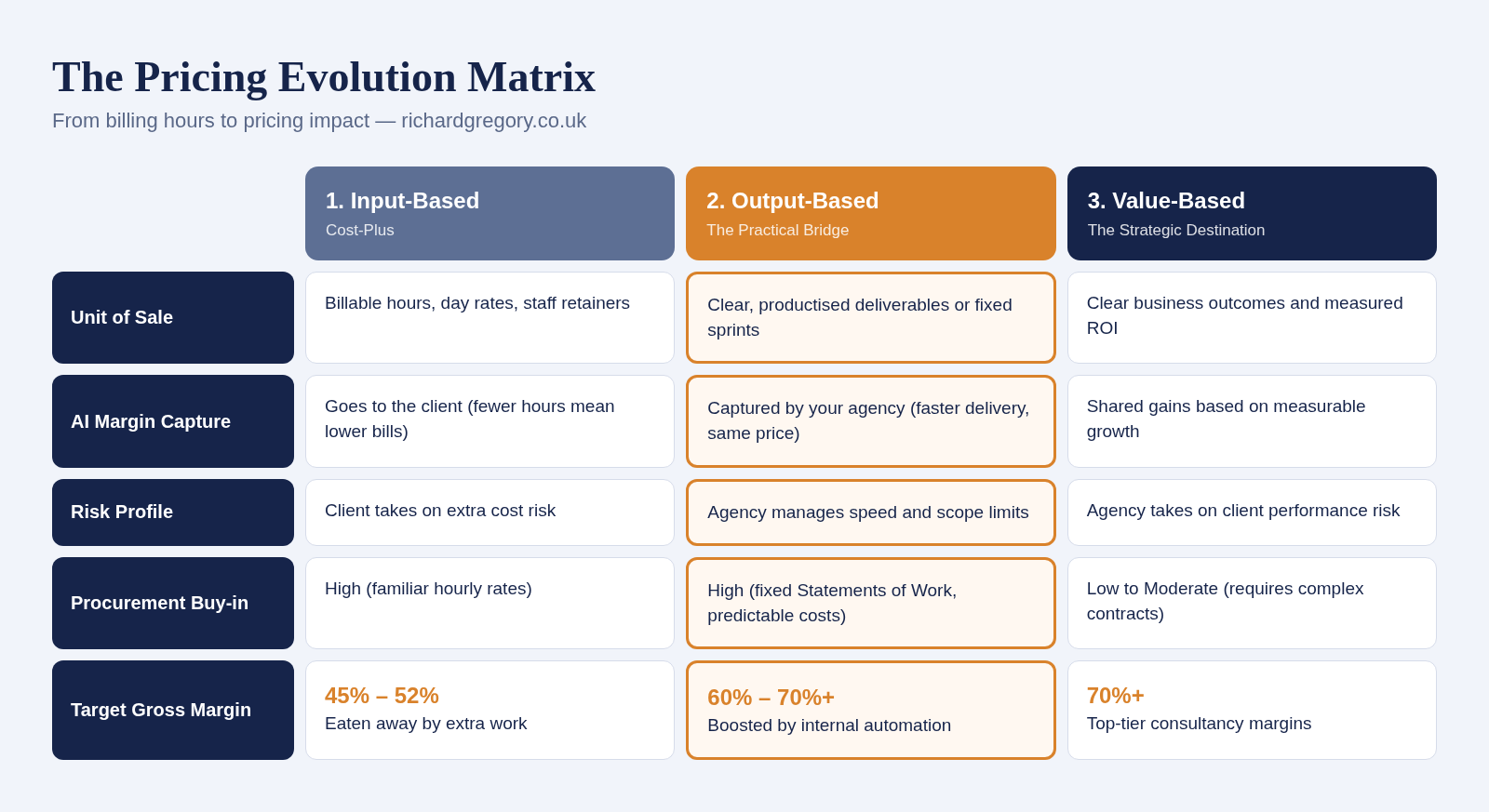
If your agency charges by the hour, generative AI is quietly wrecking your profit margins.
When a data audit or creative concept that used to take 20 billable hours now takes just 90 minutes with AI tools, hourly billing cuts your revenue by 90%. Sticking to time-and-materials basically punishes you for getting faster and limits how much your business is worth.
The ultimate goal for high-performing agencies is Value-Based Pricing (VBP): charging for the impact of your ideas rather than the hours it took to bring them to life.
However, jumping straight from hourly billing to pure value- or outcome-based contracts is a trap. For most independent agencies, Output-Based Pricing is the bridge you need first.
Why Jumping Straight to "Outcomes" Is Risky
Value-based pricing ties your fees directly to your client's business results. Long term, it's the best way to grow without needing a massive team while keeping profit margins high (20%+ EBITDA).
But moving directly to pure outcome-based pricing creates two big problems right away:
Taking on Client Risks: If your fees depend entirely on conversions, sales pipelines, or revenue shares, your profit depends on how well your client runs their business. You could build a great marketing campaign, but if their sales team drops the ball on leads, you take the hit.
Procurement Pushback: Big corporate clients often reject open-ended revenue-sharing models because of messy legal disputes over attribution and invasive audit requirements.
Trying to force this switch overnight usually causes endless debate over scoping and leaves you exposed. Agencies need a realistic stepping stone that unties billing from hours today, while building the habits needed for full value pricing later.
The Pricing Evolution Matrix
The Bridge: Keeping the Gains from AI
Output-based pricing means turning your services into fixed-scope packages. Instead of quoting "40 hours of technical consulting," you charge a fixed price for a Data & Architecture Sprint.
This gives you three clear advantages while you prepare for full value-based pricing:
Immediate Margin Boost: When AI cuts the work on a £3,000 project from 20 hours down to 4, your costs drop drastically. Under an output model, those savings stay in your business as profit instead of being passed on to the client as lower bills.
Predictable Budgets for Procurement: Corporate procurement teams prefer clear, fixed-price Statements of Work (SOWs) with defined outputs, avoiding awkward revenue-share audits.
Less Risk for You: You move away from hourly billing without taking on client issues outside your control, like supply chain delays or poor internal sales follow-up.
How to Move from Fixed Deliverables to True Value Pricing
Use the output model to stabilise operations and build what you need for full value-based pricing:
Set Strict Scope Boundaries: Fixed-price packages only work if you control scope creep. Set clear boundaries (e.g. exactly two revision rounds within five business days) and use formal Change Orders for extra requests.
Track Internal Time for Efficiency: Stop sharing hourly rate cards with clients, but keep tracking internal timesheets to monitor your effective hourly rate (target 80–90%+) and team utilisation (target 70–75%). You need to know your basic costs before pricing risk.
Charge for Scoping and Strategy: Stop giving away strategy work in pitch presentations. Charge for an initial "Discovery Sprint" or "Strategic Roadmap". Industry data shows agencies charging for initial scoping see profit margins 5% higher than those that do it for free.
Offer 3-Tier Proposals to Help Clients Transition: Give clients three options in pitch proposals:
Tier 1 (Core Output): Fixed deliverable solving the main technical problem.
Tier 2 (Fast-Track Package): Core deliverable plus priority setup and custom reporting dashboards.
Tier 3 (Hybrid Value): Core deliverable combined with ongoing support and a bonus linked to performance goals.
The Bottom Line
Basic execution work is rapidly becoming cheaper. Staying on hourly billing guarantees your income will shrink as your tools make you faster.
Package your work into fixed outputs now to keep the margin gains enabled by AI and raise profit margins above 60%. Use that extra profit to build your consulting capabilities and move confidently into true value-based pricing.