Beyond the Trade Sale: The 5 Exit Routes Every Agency Founder Should Weigh
Trade sale, cash cow, MBO, EOT or tech spinout? A boardroom comparison of the five wealth and exit routes for UK agency founders — payouts, tax, control and where each one fails.

Why building for optionality beats chasing a holding-company earn-out — and the boardroom fundamentals required to make each route work.
Most conversations around agency exits assume there is only one finish line: find an acquisitive network or private equity house, sign on the dotted line, collect a chunky cheque, and sail off into the sunset.
In reality, that neat narrative rarely survives contact with the real world.
According to BenchPress 2026 data, 67% of agency acquisitions involve staggered payment plans or earn-outs. Worse still, while just 9% of founders plan to leave immediately post-sale, 40% end up out of the door on day one because their vision and autonomy clash with the new corporate owners. If you are sweating every quarter just to hit earn-out hurdles set by an overseas parent company, that supposed payday quickly feels like a gilded cage.
Over-indexing on a trade sale narrows your options. In the boardrooms I sit in, smart founders aren't fixated on a single exit route. They build their agencies to create wealth optionality — giving them the freedom to pivot between five very distinct commercial paths.
The 5 Wealth & Exit Routes: Boardroom Comparison
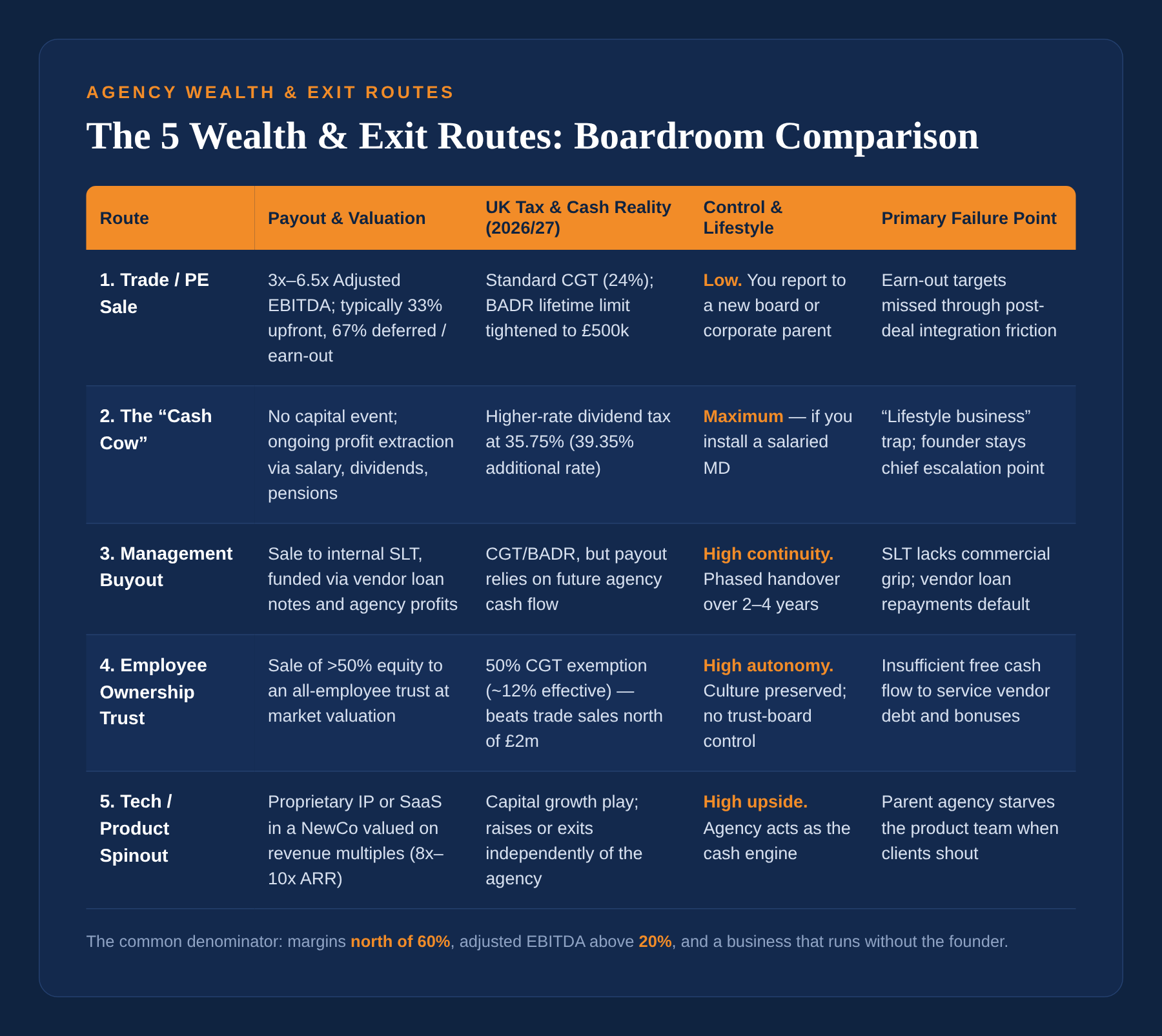
Here is how the five routes stack up when you strip away the romance and look at payouts, tax realities and operational control:
1. The Trade / PE Sale: Chasing the Big Multiple
A traditional trade or PE sale remains the headline route if your goal is an outright capital event. If you can get a deal across the line with clean terms, it can be life-changing.
However, recent tax changes have shifted the maths. With the lifetime limit for Business Asset Disposal Relief (BADR) squeezed down to £500k, more of your proceeds sit at the full 24% Capital Gains Tax rate. Furthermore, when two-thirds of your consideration is tied up in a three-year earn-out, you aren't just selling your equity; you are signing up to hit stretch targets inside an organisation you no longer control.
If you want this route, you must ensure your numbers don't collapse during due diligence. Acquirers will recut your financial model to strip out owner adjustments, client concentration risks and one-off project spikes.
2. The "Cash Cow": Dividend Machine or Hidden Job?
A lot of founders tell me: "Richard, I don't want the grief of selling. I just want to pull £250k in dividends every year."
If you can pull it off, that outcome is golden. But let's be honest about the mechanics:
Tax drag: With dividend tax rates running up to 39.35%, pulling substantial profits straight into personal income is an expensive way to extract wealth. You need a holding-company or pension structure to retain surplus capital effectively.
The founder trap: A dividend machine only works if gross margins sit comfortably north of 60% and net profit clears 20%+ after paying a market-rate Managing Director to run operations. If you are still pitching clients and putting out delivery fires, you don't own an asset — you own an exhausting, high-stress job.
3. The Management Buyout (MBO): Backing Your Second Tier
Selling to your existing leadership team offers brilliant cultural continuity. You hand over to the people who helped build the business, typically structured around vendor loan notes paid out over three to five years.
The catch? Your retirement or next venture depends entirely on whether your leadership team can manage commercial reality without you.
Great client service directors rarely arrive with balance-sheet instincts. When client retainers wobble and things get tight, will your new directors protect billable utilisation at 70–75%, or will they freeze? An MBO requires at least 18 to 24 months of board-level coaching before transaction day to ensure the team can steer the business without defaulting on your debt.
4. The Employee Ownership Trust (EOT): The Tax-Advantaged Alternative
When the Chancellor halved the EOT capital gains tax relief from 100% to 50%, many commentators prematurely declared the model dead.
They were wrong. Because BADR limits were simultaneously cut to £500k on trade sales, an EOT's 50% exemption (giving an effective CGT rate of around 12%) still beats a trade sale by hundreds of thousands of pounds on any deal north of £2m.
Better yet, there is no external buyer dictating brand strategy or slashing headcount. The crucial factor here is cash management: you must leave a sensible working-capital buffer in the business so the agency can comfortably service your vendor loan notes while distributing tax-free employee profit shares.
5. The Tech / Product Spinout: Unlocking Asymmetric Value
Agencies are valued on EBITDA multiples (typically 3x to 6x). Scalable software, proprietary AI workflows or niche SaaS platforms trade on multiples of annual recurring revenue (ARR).
If your agency has built bespoke tools that solve genuine problems for clients, spinning that IP out into a dedicated NewCo can yield multiples that dwarf the agency itself. But there is one non-negotiable rule: you must ring-fence the P&L and development team. If product engineers are constantly pulled off the roadmap to fix urgent agency client deadlines, the product will wither. If a spinout isn't gaining commercial traction, you need the discipline to pivot early or wind this up before it burns your core agency profits.
The Common Denominator: Boardroom Hygiene
Whichever route appeals to you, the underlying rule never changes: you cannot execute any of these options if the business cannot run without you.
Every route demands identical operational foundations:
Margins: Gross margin consistently north of 60% and adjusted EBITDA above 20%.
Client spread: No single client representing more than 15–20% of fee income.
Financial rigour: Clean monthly management accounts with an overhead cash buffer of at least three to four months.
Independent governance: A senior management team that owns delivery, pipeline and margin accountability.
You don't build a well-governed, high-margin agency solely to sell it. You build it so you wake up with options.
Wondering which route your agency is commercially structured to support? Run through the 5-minute Agency Scorecard or benchmark your exit readiness with the Exit Diagnostic.